

Skunk Removal & Control in Vancouver & Surrey
Mephitis mephitis (Striped Skunk)
Burrowing wildlife that den under structures and threaten pets and families with potent spray and rabies risk.
"Your pest problem
is our business"
is our business"
- RainCity Pest Control -

Pest Problem with Skunks?
Raincity can help!
Proudly Canadian
Pet Friendly

Skunks
Overview
Burrowing under decks and foundations, skunks threaten pets with spray and pose a rabies risk. Professional exclusion is the only safe way to resolve a skunk denning problem.
A Smelly Problem With Serious Consequences
Skunks are a common wildlife pest across the Lower Mainland and Fraser Valley, denning under decks, porches, garden sheds, and concrete foundations throughout the year. While their spray is the most obvious concern — causing temporary blindness and extreme distress in pets — skunks also carry rabies, dig up lawns in search of grubs, and cause structural undermining through burrowing. Attempting to evict a skunk without professional help almost invariably results in a spray event, making expert intervention the only sensible approach.


Raincity
Risk Index
Our Risk Index breaks down each pest's threat level so you know exactly what you're dealing with and how urgently to act.
Risks: Skunks
Property
Damage
6 / 10
Nuisance
Level
9 / 10
Health
Threat
7 / 10Structural & Material
Noise & Disruption
Bite & Disease Exposure
What This Means For You
Burrowing under concrete foundations, decks, and garden sheds causes structural undermining over time. Skunk spray penetrating a structure can render affected areas temporarily uninhabitable and is extremely difficult to fully eliminate from porous materials.
The threat of spray makes any outdoor activity near a known skunk den stressful. Pets that are sprayed require immediate bathing and may suffer temporary eye irritation. The distinctive odour of skunk spray can be detected from over a kilometre away.
Skunks are a primary rabies vector in North America. Skunk spray (N-butyl mercaptan) causes temporary blindness, severe nausea, and respiratory irritation. A sprayed pet is a serious welfare and household emergency requiring immediate attention.
Know Your Pest
Skunks Knowledge, Prevention Tips & Home Protection Advice.
Facts: Skunks
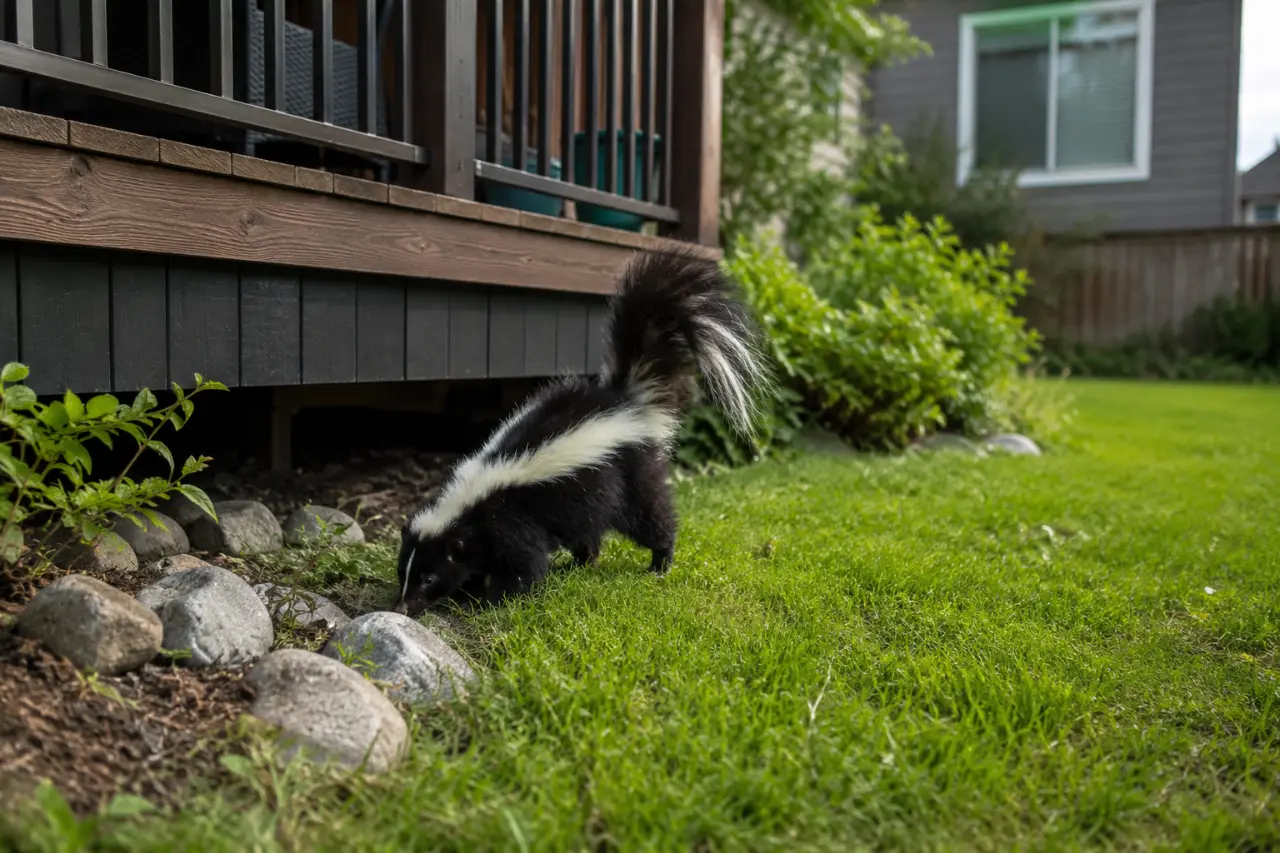
Cat-sized body 30–45cm; distinctive black fur with two white stripes running from head to tail; large bushy tail; small triangular head; short legs. Waddling gait; moves slowly and deliberately.
Omnivorous — lawn grubs, insects, small rodents, berries, garbage, and pet food left outdoors
One litter of 4–8 kits per year, born May–June; kits follow mother and learn to spray by 8 weeks
Summer
Spring
Fall
Winter



Skunks are reluctant to spray — it takes up to 10 days to replenish their supply and they give clear warning signals before spraying (foot stomping, tail raising, and a short run toward the threat). Never approach or corner a skunk. Professional exclusion using one-way doors is the only reliable method of safe removal.
Install L-shaped mesh aprons extending 30cm outward and 30cm downward around the base of all decks, sheds, and porches to prevent burrowing access. Eliminate grub populations in your lawn — skunks excavate lawns almost exclusively in search of lawn grubs, so treating for grubs removes a major attractant.
One-Way Exclusion Door System (no spray risk when correctly installed)
Any attempt to physically evict, frighten, or trap a skunk without professional expertise is extremely likely to result in a spray event. Mothballs, ammonia, and other folk remedies are not effective deterrents and may violate pesticide regulations when used in this way.
RainCity installs one-way exclusion doors that allow skunks to exit their den but not re-enter — eliminating the animal without any confrontation, spray risk, or harm to the animal. Full perimeter exclusion mesh is installed after departure to prevent re-denning.
One-way exclusion door installation at all identified den entry points, followed by full L-mesh perimeter exclusion to prevent re-entry and close all secondary access points.
One-way exclusion typically achieves full skunk departure within 3–7 days; perimeter exclusion mesh installation completed in the same visit.
Signs of Activity
Early detection prevents small issues from becoming full infestations. Watch for signs in hidden or undisturbed areas.
Skunk Odour Near Structure
The distinctive musky odour of skunk spray — or a milder version of the same scent produced by skunk gland secretions — detected near decks, foundations, or garden sheds, often strongest in the evening.
Cone-Shaped Lawn Excavations
Small, cone-shaped holes 5–10cm deep scattered across the lawn — created by skunks digging for lawn grubs just below the turf surface, typically appearing overnight in late summer and autumn.
Burrowing Under Deck or Foundation
A clearly excavated entry hole 20–25cm wide at the base of a deck, shed, porch, or concrete foundation step — the primary entry point to an active skunk den.
Skunk Sightings at Dusk
Skunks are crepuscular — most active at dawn and dusk. Regular sightings of a skunk on or near your property at these times confirms an established den nearby.
Pet Spray Event
A pet returning home smelling strongly of skunk spray is a definitive confirmation of a skunk presence on or adjacent to your property — and a sign that immediate professional attention is warranted.
Frequently Asked Questions
Find expert answers to our most common questions and discover how we keep your home or business pest-free.
The most effective home remedy is a mixture of 1 litre of 3% hydrogen peroxide, 60ml of baking soda, and 5ml of dish soap — apply immediately, leave for 5 minutes, and rinse thoroughly. Never use this mixture in a sealed container as it produces gas. Commercial skunk odour neutralisers are also effective. Tomato juice is largely ineffective.
A skunk denning under your floor or in a crawl space can spray defensively if it feels threatened, and the odour can penetrate through flooring and into living areas. This is one of the most important reasons to use professional one-way exclusion rather than any approach that might startle or corner the animal.
Yes. Beyond the spray risk, skunks are a significant rabies vector. Any pet bitten or scratched by a skunk should be taken to a veterinarian immediately, regardless of vaccination status. Keep pets vaccinated against rabies and do not allow them to investigate areas near known skunk dens.
Males may roam more widely in breeding season but females with kits will remain in a den site through summer. Skunks do not hibernate fully in BC’s mild climate and may use the same den year-round. Professional exclusion is required for reliable removal.
Skunks are classified as wildlife under BC’s Wildlife Act. Live trapping is permitted for nuisance animals but any trapping and relocation should follow provincial guidelines. Given the spray risk involved in handling trapped skunks, professional management is strongly recommended.
Ready to Get Rid of Skunks?
Let our professional team protect your home or business with proven solutions that work.
Schedule an inspection
- Local, licensed & Insured
- Fast Response & Reliable Service
- Satisfaction Guaranteed